What Makes Calais Leavers Lace Different
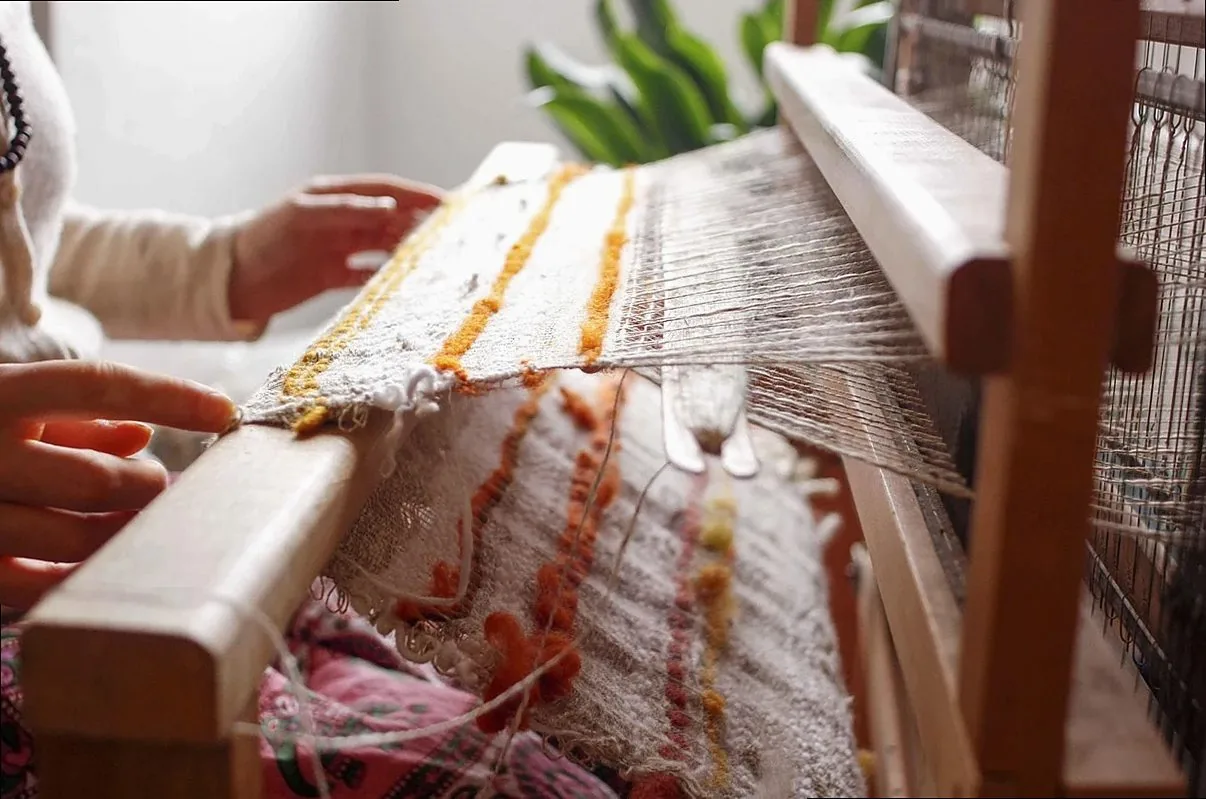
Most lace sold in lingerie today is produced on Raschel machines, which work quickly and produce a uniform fabric. Leavers lace is produced on a different type of loom entirely, one that dates to the early nineteenth century and works at a fraction of the speed. The difference is not only visual. It is tactile, structural, and, over time, durational.
How a Leavers Loom Works
A Leavers loom holds thousands of individual bobbins, each carrying a thread. The bobbins move in a pattern controlled by a Jacquard mechanism, crossing and recrossing to build the lace structure thread by thread. A single metre of lace can take several hours to produce. The resulting fabric has a slight irregularity, a quality that comes from the individual tension of each bobbin, that no two metres are precisely identical.
This irregularity is not a defect. It is what gives Leavers lace its particular quality against the skin: a softness that comes from the structure of the weave rather than from any finishing treatment. Raschel lace, by contrast, is produced in a single pass and tends to have a harder, more uniform hand.
Why Calais Specifically
Calais became the centre of Leavers lace production in the early nineteenth century, when English lacemakers brought their looms across the Channel. The industry grew through the nineteenth and early twentieth centuries, and at its peak the town had several hundred mills operating. The number has declined sharply since the 1980s, and fewer than forty Leavers looms remain operational in Calais today.
The mills that remain tend to supply couture houses, a small number of specialist lingerie makers, and a few theatrical costume suppliers. The fabric they produce is not interchangeable with what is available through general textile wholesalers. Access to it requires a direct relationship with the mill.
Identifying Leavers Lace in a Finished Garment
In a finished garment, Leavers lace can be identified by holding it to the light. The pattern should show slight variations in thread density across the width of the fabric. The edges, if unfinished, should not fray in the way that Raschel lace does. The hand should be soft without being limp.
Price is also an indicator. Leavers lace costs significantly more per metre than Raschel lace, and garments made with it are priced accordingly. A bralette using genuine Leavers lace panels will not be inexpensive. If the price suggests otherwise, the lace is almost certainly Raschel.
The distinction matters most over time. Leavers lace, properly cared for, holds its structure through years of gentle washing. Raschel lace tends to distort after repeated wear. For a piece you intend to keep, the material is the investment.